
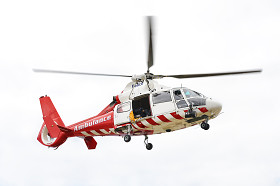
 An abstract presented by John Holcomb and colleagues at the 2013 American Heart Association Meeting in November showed that pre-hospital transfusion of plasma and/or RBCs in trauma patients increased survival and improved coagulation status. Over a 15 month period, the team retrospectively analyzed over 6000 adult trauma cases arriving by ground or helicopter. Of the 577 cases which met inclusion criteria, 97 trauma patients receiving pre-hospital transfusion had reduced risk for mortality within the first 6 hours (adjusted odds ratio (OR)=0.08, p=0.04) and coagulopathy on arrival (adjusted OR=0.40, p=0.02). The authors concluded that pre-hospital transfusion was associated with a reduction in the risk of death and improved coagulation status with minimal blood product wasted (1.9%).
Reference
1. Holcomb JB, Donathan DP, Junco DJd, Brown G, Wenckstern Tv, Podbielski JM, et al. Initial Results for Pre-Hospital Transfusion of Plasma and RBCs in Trauma Patients. In: American Heart Association Meeting. Dallas, Texas; 2013.

