
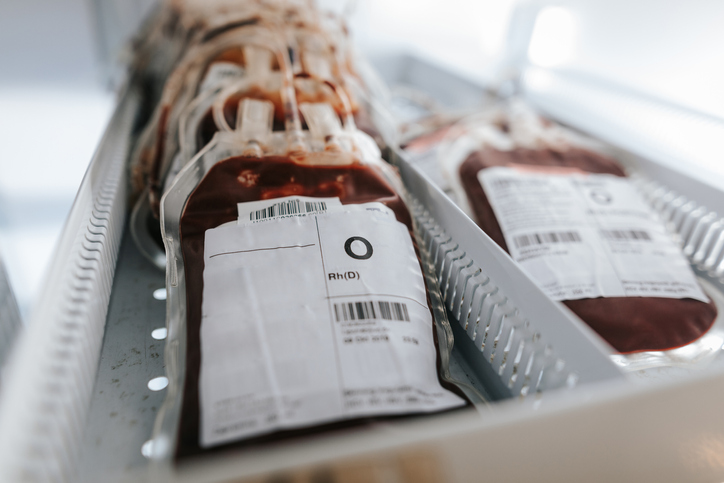
Low-titer whole blood is increasingly used during prehospital transfusions for both military and civilian trauma patients because the logistics of storage and transfusion are simpler compared with blood components (red cells and plasma). Prehospital transfusion reduces mortality in patients who have experienced major trauma and hemorrhage, but it is unclear whether whole blood is safer or more effective than blood components at reducing mortality or hemorrhage. The Type O Whole Blood and Assessment of Age during Prehospital Resuscitation (TOWAR) trial randomized 44 air medical bases at 11 trauma centers in the U.S. and Canada in a 2:1 ratio to transfuse up to 2 units during prehospital resuscitation of either low-titer (low anti-A and anti-B antibody titers) whole blood or blood components (red cells and/or plasma) for fixed 1-month blocks. Of the 1020 trauma patients (74% male; median Injury Severity Score, 25) enrolled in the study, 695 received whole blood stored up to 21 days and 298 received blood components. No significant difference in mortality was observed between the arms—26% (180/695) patients in the whole blood arm died within 30 days compared to 21% (61/298) in the component arm (adjusted odds ratio, 1.24; 95% C.I., 0.87 to 1.76; p=0.24). In addition, 30-day mortality was similar between patients who received whole blood stored for 15-21 days compared to those who received whole blood stored for 1-14 days (27% vs. 26%, respectively). While prehospital whole blood transfusion is a safe alternative, it is not superior to component therapy for trauma patients.
Reference:


Leave a Reply